Responsible AI is an engineering and governance practice for identifying and managing impacts throughout an AI system's lifecycle. For a production system, this means defining intended use, understanding affected people and data, measuring behavior, applying controls, and monitoring outcomes after release. It is not a guarantee that a system is risk-free. NIST AI Risk Management Framework
Why responsible AI matters
AI systems can shape access to services, information, and business decisions. Risks depend on the use case, users, data, model behavior, and surrounding process. Review those conditions before selecting controls, then reassess when the system, its data, or its operating context changes.
NIST's AI Risk Management Framework (AI RMF) provides a voluntary structure for incorporating trustworthiness considerations into the design, development, use, and evaluation of AI systems. Its characteristics include validity and reliability, safety, security and resilience, accountability and transparency, explainability, privacy enhancement, and fairness with harmful bias managed. These are properties to assess in context, not a universal score that a model can pass once and be considered trustworthy. NIST AI RMF, NIST AI RMF FAQs
Core principles
Microsoft describes six Responsible AI principles: fairness, reliability and safety, privacy and security, inclusiveness, transparency, and accountability. Organizations can use them as a review vocabulary, while defining measurable requirements and ownership for each system. Fairness measures depend on the decisions and affected groups; a single metric or parity target will not resolve every policy question. Microsoft Responsible AI principles
| Principle | Engineering question |
|---|---|
| Fairness | Which groups may experience different error rates or outcomes, and how will those differences be assessed? |
| Reliability and safety | How does the system behave under expected, edge, and failure conditions? |
| Privacy and security | Which data is collected, retained, exposed to models, or written to telemetry? |
| Inclusiveness | Can the intended users access and use the system across relevant abilities, languages, and contexts? |
| Transparency | Can users understand the system's purpose, limits, and role in a decision? |
| Accountability | Who approves release, responds to incidents, and owns remediation? |
Governance across the AI lifecycle
Governance turns policy into repeatable decisions: who can propose a use case, how its risk is assessed, who approves release, and how incidents and changes are handled. ISO/IEC 42001 specifies requirements for an AI management system and continual improvement. It supports organizational governance; it does not replace technical threat modeling or product-specific evaluation. ISO/IEC 42001:2023
A useful governance process defines:
- Intended and prohibited uses, accountable owners, and affected stakeholders.
- Data sources, legal basis, sensitivity, retention, and access rules.
- Risk criteria and the evidence required to approve deployment.
- Human review and escalation paths for consequential outcomes.
- Monitoring, incident response, rollback, and change review.
Security by design
Security is part of responsible AI because models and agents operate over data, identities, APIs, and connected systems. Apply least privilege to user, service, and agent identities; validate inputs and outputs at application boundaries; protect secrets and sensitive data; and enforce authorization in downstream services. For retrieval systems, filter by trusted permissions before content enters the model context. For agents, constrain tools and require approval for high-impact actions.
Security controls should be tested against prompt injection, data leakage, insecure output handling, unauthorized tool calls, and dependency or model changes. Red-team exercises are useful when they are scoped to a threat model and followed by verified remediation. Microsoft Learn: Apply responsible AI
The NIST AI RMF approach
The NIST AI RMF organizes risk management into four functions: Govern, Map, Measure, and Manage. The diagram presents them as a repeating cycle because evaluation and operational evidence should update governance and risk decisions over time. NIST AI RMF
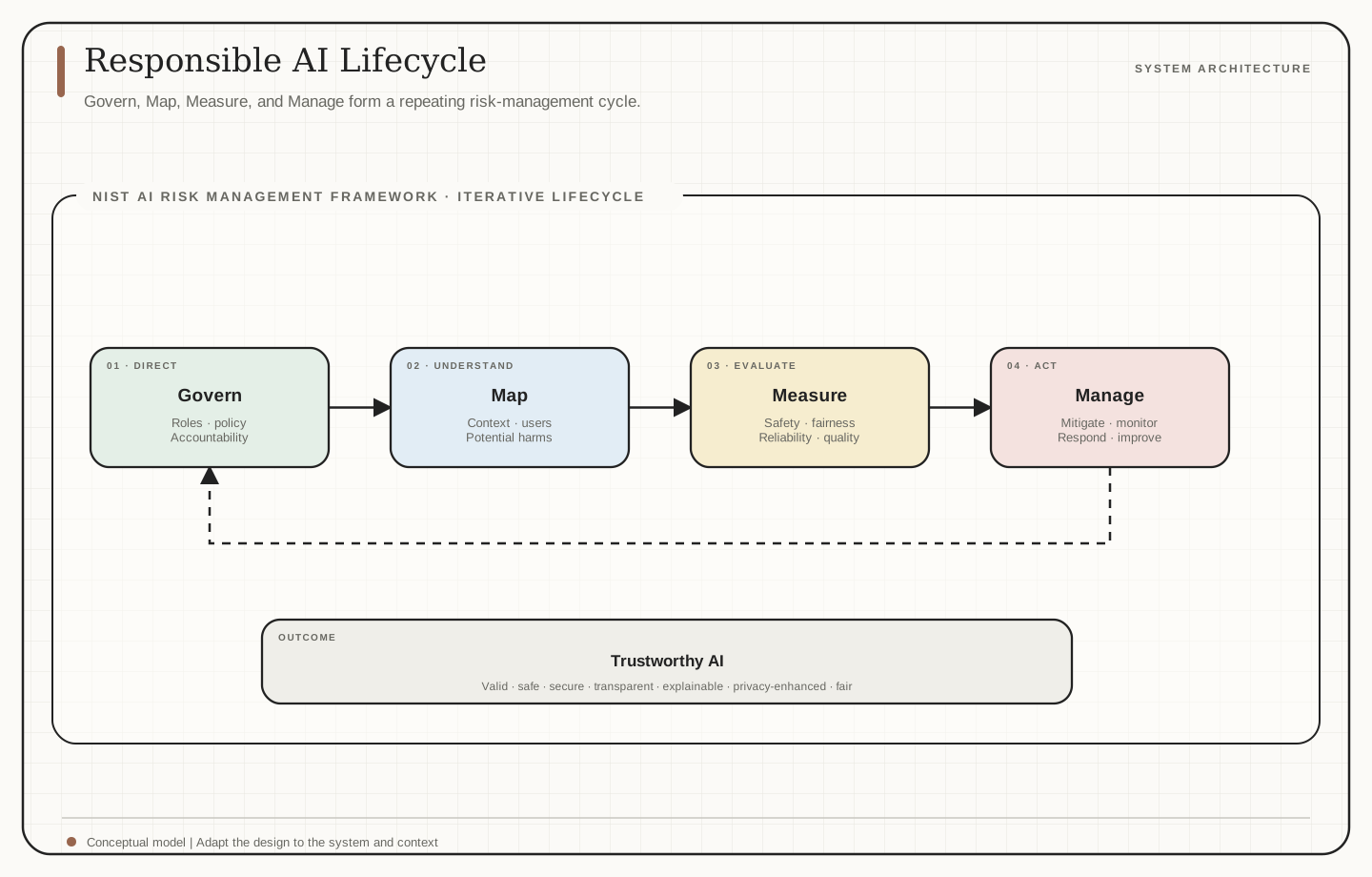
- Govern: Establish policy, roles, accountability, and risk tolerance.
- Map: Document intended use, context, affected people, and potential impacts.
- Measure: Evaluate system performance and risks with suitable quantitative and qualitative methods.
- Manage: Prioritize risks, apply mitigations, monitor residual risk, and respond to issues.
NIST describes the AI RMF as voluntary and is revising version 1.0. Check the current framework and any relevant profiles when applying it to a project. It is a risk-management framework, not a certification that a specific AI system is safe or compliant. NIST AI RMF
Building trust with users
Trust depends on the system's actual behavior and the process around it. Explain what the AI component does, disclose relevant limits, provide ways to challenge or escalate consequential outputs, and keep a human owner accountable. Reviewers need the evidence and authority to intervene; a nominal approval step is not meaningful oversight.
For agent systems, map the full path from user identity through retrieval and tool execution. Microsoft's Responsible AI guidance for agents recommends addressing risks during design and maintaining controls after launch. Microsoft Learn: Apply responsible AI
A practical implementation checklist
- Define intended users, purpose, prohibited uses, and accountable owners.
- Map data, identities, model endpoints, tools, and downstream decisions.
- Identify potential harms and set risk-based evaluation criteria.
- Test performance and safety across representative users, inputs, and failure conditions.
- Enforce permission checks and least privilege at each service boundary.
- Establish human review thresholds and a clear escalation path.
- Limit sensitive logging, restrict trace access, and set retention periods.
- Monitor outcomes and incidents after release.
- Reassess risks when data, models, prompts, tools, or context change.
Conclusion
Responsible AI becomes actionable when principles connect to owners, engineering controls, evaluation evidence, and operational response. The NIST functions in the diagram provide a useful cycle for organizing that work; teams still need to define controls that fit their system and its risks.
References
- National Institute of Standards and Technology. AI Risk Management Framework
- National Institute of Standards and Technology. AI RMF FAQs
- Microsoft. Responsible AI principles and approach
- International Organization for Standardization. ISO/IEC 42001:2023, AI management systems
- Microsoft Learn. Apply responsible AI