On 17 November 2023, I wrote a short overview of ways artificial intelligence might support South African mining, from exploration and mine planning to maintenance, safety, and risk management. The original article was optimistic and intentionally broad. Looking back, I still recognize the opportunities I described. I would now be more precise about the distance between a promising use case and a dependable system at a mine site.
What I was trying to capture
The article was a map of possibilities. AI could help teams interpret geological data, plan extraction, anticipate equipment problems, monitor site conditions, and make decisions with more evidence. Those remain useful areas to explore. But the phrase “AI can” made very different things sound equally ready: a model that flags an unusual vibration pattern is not the same kind of system as an autonomous machine operating near people underground.
I would now describe those examples as questions to investigate, not outcomes to promise. A model can identify patterns in the data it receives. Whether that pattern leads to a better maintenance decision, a safer operation, or a viable exploration target depends on data quality, the operating context, and how people use the result.
Start with the operating problem
If I were rewriting the post today, I would begin with a specific decision that a mining team needs to make. For example: can maintenance planners identify a developing failure early enough to schedule an intervention without creating unnecessary work or missed failures?
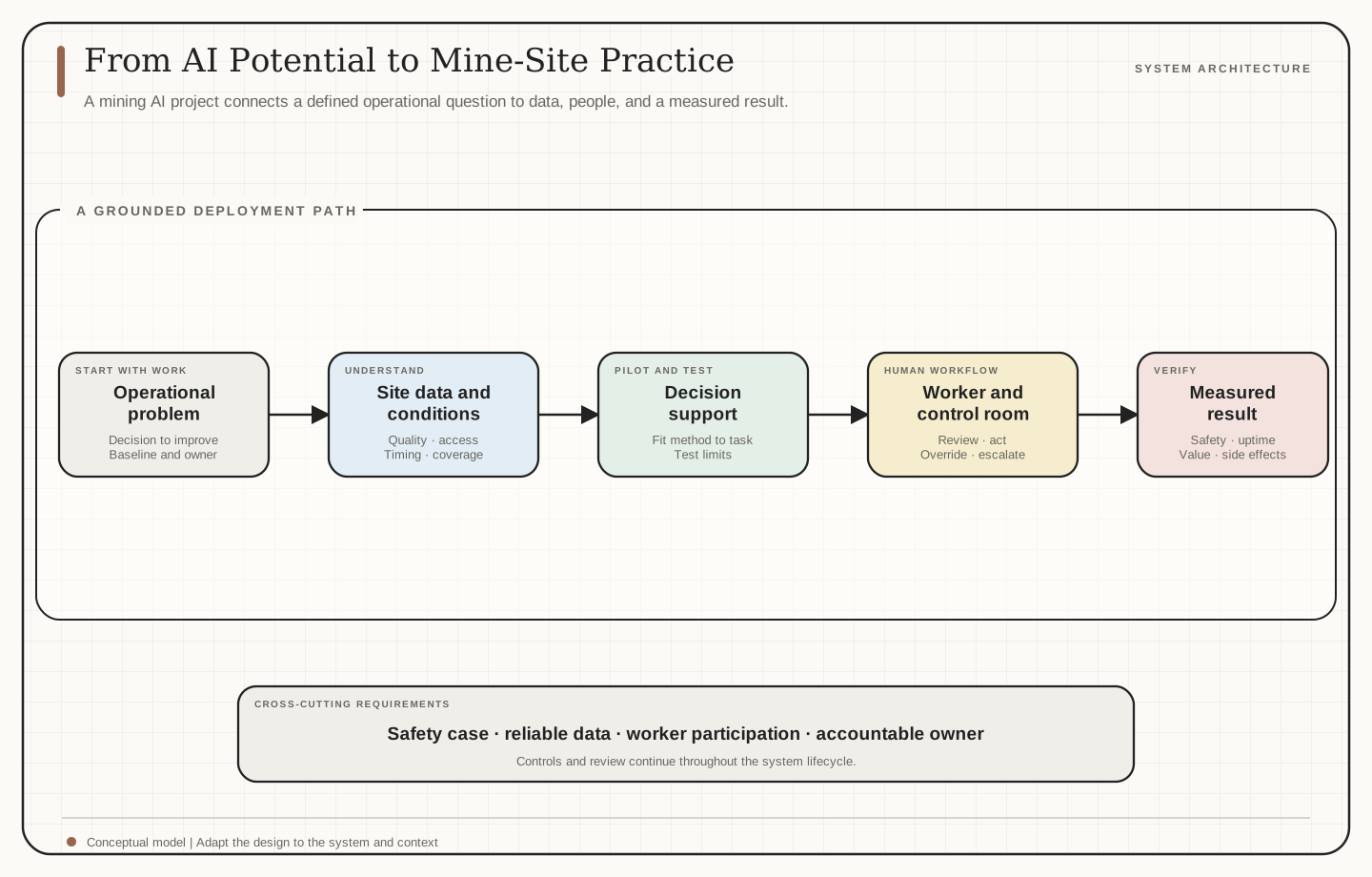
Then I would ask what information is available, whether it reflects the relevant failure modes, how quickly it arrives, and who will act on a model output. That is a more useful starting point than choosing an AI technique first. The Global Mining Guidelines Group’s updated framework similarly emphasizes defining an operational problem, organizing data, piloting a solution, validating the results, and involving end users. GMG (2026)
That approach also helps distinguish between methods. A forecasting model for equipment telemetry, computer vision for a defined inspection task, geological models for exploration, and an optimization system for scheduling have different data needs, failure modes, and acceptance criteria. They should not be grouped under one broad promise of “AI transformation.”
Be more careful with safety claims
My 2023 post suggested drones or robots could help locate or assist trapped miners. I would qualify that example today. A capability demonstrated in a controlled setting is not automatically safe or ready for emergency use underground. Communications, power, environmental conditions, equipment reliability, and the mine’s emergency procedures all matter. AI may support a response team with information, but it should not be described as a rescue capability without operational evidence and a clear safety case.
For any system that can influence a safety-critical decision, I would define the allowed role of the model, how its output is checked, what happens when data is missing or unreliable, and who retains authority. NIST’s AI Risk Management Framework calls for context-specific assessment, documented human oversight, testing under conditions similar to deployment, and safe responses to failures. NIST AI RMF
Keep people in the design
The original article focused mostly on technical opportunities. A stronger version would give equal weight to the people who work with the systems and the communities affected by mining. Modernisation changes tasks, skills, and decision-making. The Minerals Council of South Africa’s recent showcase describes AI and broader modernisation in connection with productivity, safety, health, sustainability, and workforce development. Minerals Council South Africa (2026)
That matters in the design itself. Operators and maintenance teams should help identify useful signals, review recommendations, and report when the system does not fit how work is actually done. Training, accountability, and a way to challenge or override a recommendation are part of the implementation, not a later change-management exercise.
What I would measure now
Before deployment, I would compare a proposed system with the current process and agree on measures that reflect the real decision. For maintenance, that might include missed failures, unnecessary inspections, downtime, and whether the warning arrived early enough to act. For safety support, model accuracy alone would be insufficient: the team would also need to test response time, failure behavior, and performance under site conditions.
I would keep monitoring after launch. Equipment, data collection, operating procedures, and mine conditions change. A model that performed well during a pilot can become less useful if its inputs or context shift. The team needs an owner, a review process, and a way to pause or roll back the system when its evidence no longer supports its use.
Looking back
I still believe AI can contribute to South African mining. What has changed is the standard I would apply before making that claim. I would move from listing what AI might do to explaining which decision it supports, what evidence it needs, how workers remain in control, how the result will be measured, and what happens when the system fails.
The original post captured my curiosity about the possibilities. A more mature version would keep that curiosity and add the engineering discipline to test each possibility against the realities of a mine.
References
- Sekhebesa, J. (2023, November 17). The application of AI in South African Mining Industry. Medium
- Global Mining Guidelines Group. (2026, July 20). Foundations of AI: A Framework for AI in Mining (Updated Version). GMG
- NIST. (2023). Artificial Intelligence Risk Management Framework 1.0: Core. NIST AI Resource Center
- Minerals Council South Africa. (2026, July 23). Mining Modernisation Showcase. Minerals Council South Africa