Becoming an AI engineer in 2026 is less about learning every new model or framework and more about building the judgment to turn a real problem into dependable software. The role can mean different things across companies. In an applied engineering role, the work often spans programming, data, model integration, security, deployment, and ongoing operation. Microsoft's current Azure AI Cloud Developer role description is one example of that full lifecycle scope, though no single certification defines the profession. Microsoft Learn
The most useful learning path builds one layer at a time. Start with skills that help you build and debug ordinary software, then learn how to evaluate models, and finally learn to operate AI systems under real constraints.
Start with software and data foundations
Choose a primary language and become comfortable using it to build small, reliable applications. Python is a common choice for AI work. Learn to structure a project, use Git, write tests, work with files and databases, call HTTP APIs, handle errors, and read logs. SQL is valuable because many AI features depend on finding, joining, and checking the data that already exists in an organization.
You do not need to become an expert in every infrastructure tool before you can build a useful AI feature. You do need to know how to trace a request through code and understand where input data comes from, how it is transformed, and what happens when a dependency fails.
Learn enough machine learning to judge results
Understand the basic ideas behind training and evaluation: features and labels, training and test data, overfitting, data leakage, class imbalance, and the difference between precision and recall. These concepts help you notice when a high score hides a weak model or an unrepresentative dataset.
Build a small prediction project before relying only on a hosted language model. Define a baseline, split data without leaking information, select metrics based on the cost of different errors, and inspect examples the model gets wrong. Google's refreshed Machine Learning Crash Course covers these foundations along with data preparation, generalization, production ML systems, and responsible engineering. Google Machine Learning Crash Course
You do not need to train a large model from scratch to become an AI engineer. You do need enough understanding to decide when a model is appropriate, what evidence would show that it works, and when a simpler rule or conventional application is a better fit.
Build one useful AI application
After the foundations, build a small application around a clearly defined user task. If the application needs to answer from a set of documents, learn retrieval and grounding. If it needs a model to take an action, expose a narrow tool and enforce permissions in application code. If it needs to classify or extract information, compare a model with simpler approaches using the same test cases.
Treat the model as one component in a software system. Add input validation, timeouts, retries with limits, structured output checks, authentication, and a fallback for unavailable services. Keep secrets out of source control, and do not assume that instructions in a prompt enforce access control.
Security should be part of the first design, especially for language model applications. OWASP's 2025 guidance covers risks such as prompt injection, sensitive information disclosure, improper output handling, and excessive agency. Use it to create concrete abuse cases for your project, such as a malicious document, an unauthorized request, or an unexpected tool call. OWASP Gen AI Security Project
Evaluate before you polish
Create a small evaluation set from realistic requests before spending time tuning prompts or adding a complex agent framework. Include ordinary examples, ambiguous cases, missing information, denied access, and failure conditions. Keep the examples separate from the material used to design the solution where practical, so the evaluation can reveal problems rather than reward memorization.
Choose measures that reflect the task. For document question answering, check whether retrieved passages are relevant, whether answers are supported by those passages, and whether citations point to the right sources. For an agent, check task completion, tool choice, argument validity, permission handling, and whether it stops or asks for help when needed.
Evaluation is ongoing work. Run it when prompts, models, tools, or data change, then compare results with a known baseline. Microsoft Foundry's evaluation guidance describes evaluating test datasets, model or agent responses, and production traces across development and deployment. Microsoft Foundry evaluation
Learn to deploy and operate the system
A convincing project does not end when it works on your laptop. Learn to configure an application for deployment, use managed identity or other appropriate authentication, separate development and production settings, and monitor errors, latency, usage, and cost. Understand how you would roll back a change and how you would tell if the system's inputs or behavior have shifted.
Responsible deployment also means identifying who owns the system, who can act on its recommendations, what data it handles, and how people can report a problem. The NIST AI Risk Management Framework is a voluntary resource for incorporating trustworthiness into the design, development, use, and evaluation of AI systems. Use its concepts to make risks and responsibilities explicit for your particular project. NIST AI Risk Management Framework
Build a portfolio that shows engineering judgment
Two complete projects usually show more than a long list of disconnected demos. For each project, explain:
- The problem: Who has the problem, and what does the current process do?
- The design: Why did you choose this model or method, and what alternatives did you consider?
- The evidence: What data and test cases did you use, and what did the system get wrong?
- The controls: How are identity, permissions, privacy, and failure behavior handled?
- The operation: How would you monitor quality, cost, and changes after release?
One project might use conventional machine learning for a prediction task. Another might use retrieval or a model API in an application. Make the code reproducible, document limitations, and show the actual evaluation results. A polished interface helps, but it cannot replace evidence that the system solves the stated problem.
A practical learning path
Treat each stage as evidence of a skill, not a badge to collect. Build something small and explain what you learned before moving to the next layer.
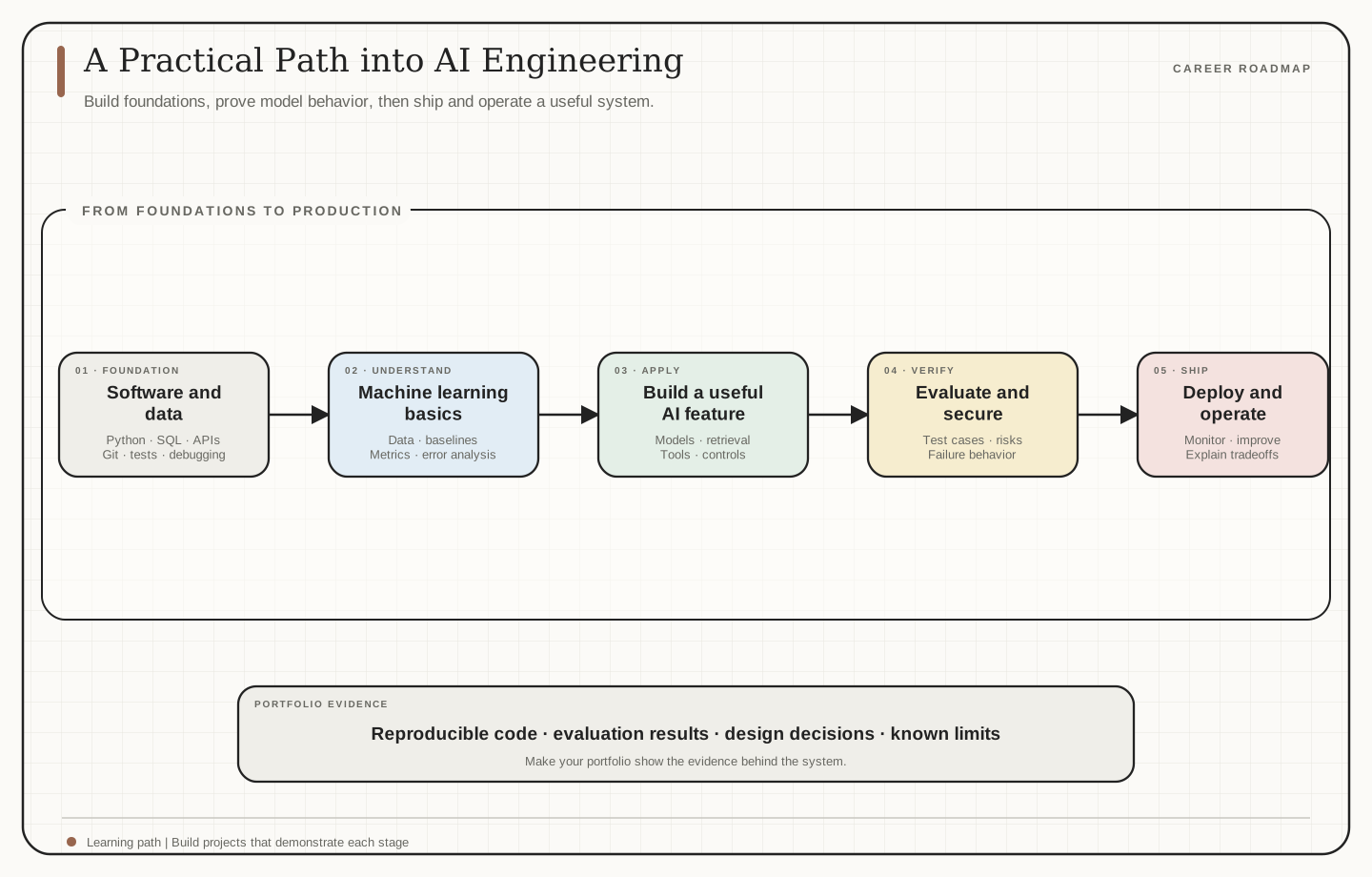
- Build comfort with Python, Git, SQL, APIs, tests, and debugging.
- Study core ML concepts and complete a small, measured prediction project.
- Build an AI feature around one user need, adding only the model capabilities it requires.
- Add evaluation cases, security checks, monitoring, and deployment steps.
- Write up the tradeoffs and failures as clearly as the successful path.
The time this takes depends on what you already know and how consistently you can practise. A course can provide structure, and a certification can demonstrate familiarity with a platform, but neither replaces building, testing, and explaining a working system.
Conclusion
The strongest route into AI engineering is to keep moving from concepts to working systems. Learn the software and data foundations, understand model behavior well enough to test it, build one useful application, and prove how it behaves under realistic conditions. Tools will continue to change. The ability to make sound engineering decisions around them is what lasts.
References
- Microsoft Learn. Microsoft Certified: Azure AI Cloud Developer Associate. Certification overview
- Google for Developers. Machine Learning Crash Course. Course
- OWASP Gen AI Security Project. 2025 Top 10 Risk & Mitigations for LLMs and Gen AI Apps. OWASP Top 10
- Microsoft Learn. Evaluation in Microsoft Foundry. Documentation
- National Institute of Standards and Technology. AI Risk Management Framework. NIST