An AI gateway provides a shared boundary between applications and AI backends. Azure API Management extends its API gateway capabilities to model APIs, agents, and tools. Depending on the service tier and configuration, teams can apply authentication, authorization, token policies, content-safety checks, routing, and telemetry. These controls reduce duplicated client logic, but they do not replace authorization in the application or backend. Microsoft Learn: AI gateway in Azure API Management
Why AI workloads need a gateway
When each application calls model providers directly, credentials, usage controls, logging, and backend changes can become inconsistent. A gateway gives platform teams a place to manage shared traffic policies and observe usage across consumers. It also introduces a dependency in the request path, so teams should plan capacity, regional availability, and a fallback strategy.
Azure API Management can import supported model APIs, authenticate to Azure AI backends with managed identity, apply policies such as token limits and content safety, and route requests to configured backends. Feature availability varies by API Management tier. Some newer offerings, including the AI Gateway tier and unified model API, are documented as preview features; confirm their current regions, limits, and service-level terms before selecting them for production. AI gateway capabilities, AI Gateway tier overview
Core governance capabilities
| Capability | Engineering purpose |
|---|---|
| Authentication and authorization | Authenticate application callers and configure backend credentials independently. |
| Token rate limits and quotas | Allocate model capacity by consumer and limit runaway use. |
| Content-safety policies | Apply configured moderation checks to supported LLM traffic. |
| Routing and load balancing | Send requests to configured backends and manage backend resiliency. |
| Telemetry | Track request outcomes and, when configured, token usage and other AI signals. |
| MCP and agent APIs | Govern supported tool or agent endpoints where the selected tier and configuration allow them. |
Token policies can enforce limits using a consumer key and a time period. They do not guarantee a fixed spend unless token prices, retries, provider charges, and other usage are included in the budget model. Logging prompts and completions can help debugging and auditing, but it also creates sensitive data stores. Define redaction, access, and retention before enabling that logging. AI gateway capabilities
Secure model access
A production design should separate the application-to-gateway credential from the gateway-to-backend identity. Use Microsoft Entra authentication or another supported caller mechanism, and use managed identity for Azure backends where possible. Apply per-consumer policies, but enforce authorization again in each backend. A gateway that authenticates a request does not automatically prove that the caller may read a particular document or perform a business action.
Treat model and tool traffic according to its sensitivity. Avoid logging full prompts by default if they may contain customer data, credentials, or confidential records. Restrict access to telemetry and set a retention period that meets operational and regulatory requirements.
Reference architecture
The diagram shows a conceptual flow from applications through an API Management policy boundary to model endpoints and business APIs, with monitoring below the gateway. A practical implementation should also include controls at the application, identity provider, and each backend:
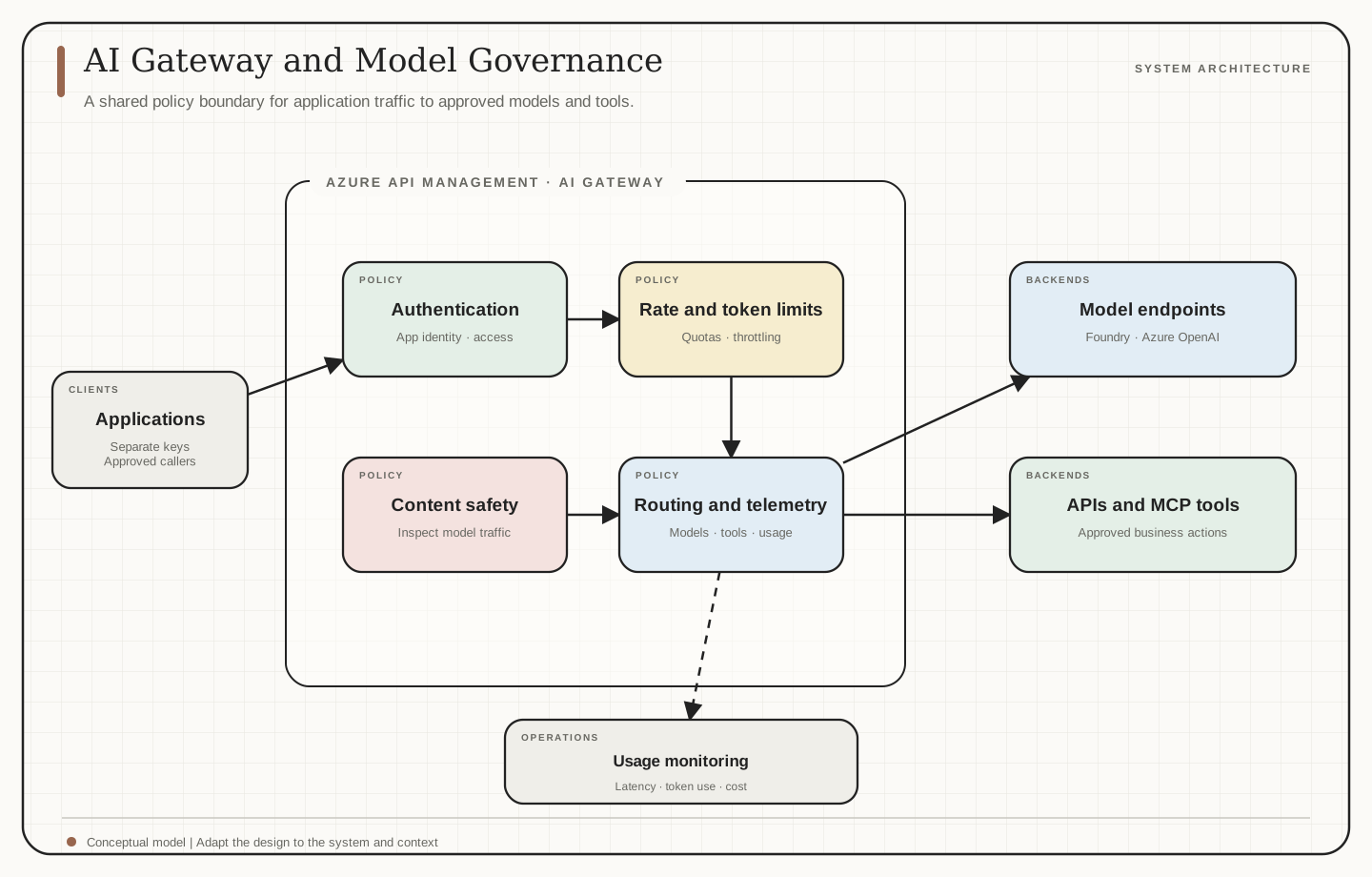
- The application authenticates its user and sends an authorized request to the gateway.
- The gateway authenticates the application and applies configured policies.
- The gateway routes the request to an approved model or tool backend.
- The backend independently authorizes the operation and returns a result.
- Telemetry records the operational signals needed for evaluation and incident response.
The diagram does not imply that every policy or feature is available on every API Management tier. Check service documentation and validate the actual tier, regions, APIs, and policies selected for deployment. AI gateway capabilities
Conclusion
An AI gateway can centralize traffic controls and make model operations easier to manage. It is one layer in a wider trust boundary. Keep user authorization, tool permissions, data access, and sensitive logging controls explicit at every backend, and verify feature availability for the chosen API Management tier.
References
- Microsoft Learn. AI gateway capabilities in Azure API Management
- Microsoft Learn. AI Gateway tier (preview) overview
- Microsoft Learn. Govern and secure assets in AI Gateway tier (preview)
- Microsoft Azure. Azure API Management