Agentic AI describes systems that use a model to select and execute steps toward a goal. An agent may call tools, observe their results, and continue or hand off work based on what it learns. In a business workflow, this can help with tasks that contain variable inputs or exceptions. It does not make every process a good candidate for autonomy. Li et al. (2026)
What makes AI agentic?
There is no universal checklist that makes a system an agent. In practice, an agent combines a model with instructions, a bounded set of tools, state, and a runtime that decides what to do next. Memory is optional. The important engineering distinction is whether the system can choose actions at runtime, rather than only execute a fixed sequence of application-defined steps. Bandara et al. (2025)
A useful agent also needs an explicit stopping condition. Define what counts as success, which actions are permitted, what evidence each action requires, and when the system must ask a person. Tool schemas should be narrow and validate inputs at the application boundary. The model can propose a call; application code and downstream services must authorize and validate it.
Why collaborative agents matter
A multi-agent design can help when a workflow contains distinct tasks that can be handled independently or in parallel. A coordinator can assign bounded work to specialist agents, reconcile their results, and route exceptions. The extra agents also add coordination overhead, latency, cost, and more failure points. Start with one agent or deterministic application logic, then split responsibilities only when evaluation shows a clear benefit. Li et al. (2026), Bandara et al. (2025)
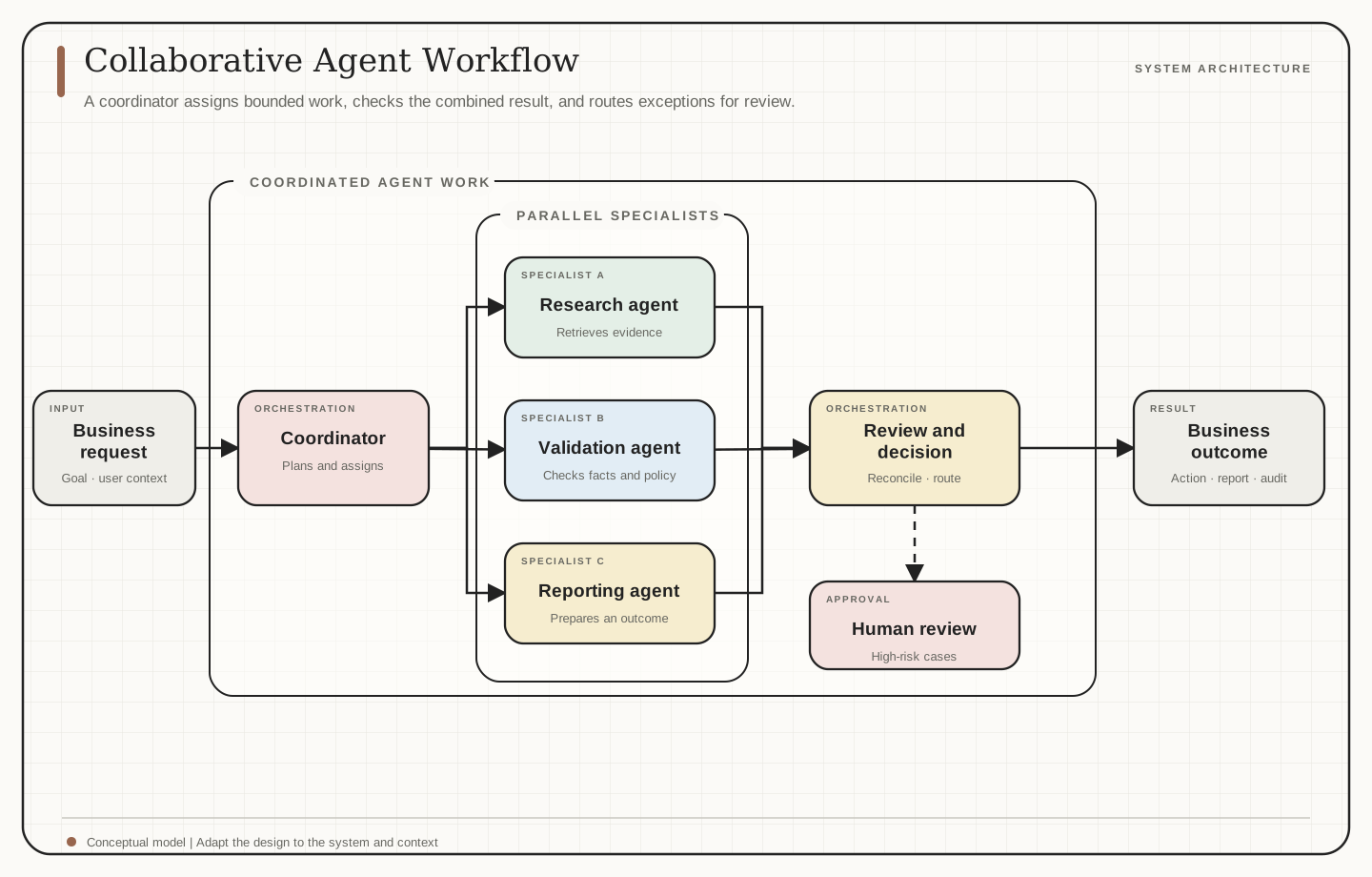
Consider a customer-support case. A coordinator assigns one agent to retrieve relevant account and policy evidence, another to check the proposed response against policy, and a reporting agent to prepare a concise summary. A review step reconciles the work. High-impact or ambiguous cases go to a human before the system takes action. This matches the workflow shown in the diagram: request, coordination, parallel specialists, decision, exception review, and outcome.
Business benefits
The strongest use cases involve multi-step work with clear boundaries, accessible data, and measurable outcomes. Examples include intake and triage, knowledge-assisted support, document review, and operational research. These are candidates for assisted automation, not proof that an agent will outperform a conventional workflow. Establish a baseline for completion rate, error rate, handling time, and cost before rollout. Industry research describes potential for agents to coordinate across systems, while also emphasizing that organizations need the right data and operating foundation. Bain & Company (2025), Deloitte (2025)
The secure foundation
Treat an agent as a privileged application that can access data and invoke operations. Authenticate users and services, authorize every retrieval and tool call, and keep credentials out of prompts and model context. If an agent acts on a user's behalf, use a supported delegated authorization flow. Otherwise, give it a distinct service identity with only the permissions needed for its task.
A production design should include:
- Least privilege: Limit each identity and tool to the smallest useful scope.
- Human review: Require approval for sensitive, irreversible, or externally visible actions.
- Validation: Check tool arguments and results in application code and in the downstream service.
- Traceability: Record the request, evidence used, policy decision, tool call, and outcome, subject to privacy and retention controls.
- Evaluation: Test expected behavior, denied actions, ambiguous requests, tool failures, and adversarial inputs.
- Operational limits: Set timeouts, retry limits, rate limits, and cost budgets.
These controls align with production engineering guidance for agentic workflows and the secure-by-design foundations described in enterprise research. Bandara et al. (2025), IBM Institute for Business Value
Responsible deployment principles
Keep a named owner accountable for the workflow, even when agents perform parts of it. Document the intended use, prohibited actions, escalation path, data sources, and success measures. Human approval is useful only when reviewers receive enough evidence and time to make a decision; it should not be treated as a substitute for technical authorization or output validation.
Use deterministic code for rules that must be applied consistently, such as eligibility checks, transaction limits, and access decisions. Reserve model judgment for interpretation or synthesis where it adds value. Reassess the system when prompts, models, tools, data, or policies change. Bandara et al. (2025)
How to get started
- Select a bounded workflow. Identify users, inputs, decisions, actions, exceptions, and a baseline for quality and cost.
- Map its trust boundaries. Identify data owners, identity flows, permissions, tool endpoints, and human approval points.
- Build the smallest useful version. Begin with one agent or a deterministic workflow. Add specialist agents only for separable tasks.
- Evaluate before expanding. Test routine cases, edge cases, denied requests, prompt injection, and service failures.
- Deploy with operational controls. Add monitoring, rate limits, rollback, incident ownership, and a process for reviewing failures.
Conclusion
Collaborative agents are useful when coordination across bounded tasks solves a real workflow problem. A reliable design makes responsibilities, permissions, evidence, and handoffs explicit. Measure the result against a simpler baseline, and expand autonomy only when the evidence supports it.
References
- Li, M. M., Reinhard, P., & Leimeister, J. M. (2026). Agentic AI: From Autonomous Agents to Enterprise Agentic AI Systems. Business & Information Systems Engineering. Article
- Bandara, E., et al. (2025). A Practical Guide for Designing, Developing, and Deploying Production-Grade Agentic AI Workflows. arXiv preprint. arXiv:2512.08769
- Bain & Company. (2025). Building the Foundation for Agentic AI. Report
- Deloitte. (2025, December 10). The agentic reality check: Preparing for a silicon-based workforce. Deloitte Insights
- IBM Institute for Business Value. (n.d.). The essential guide to agentic AI. Report